
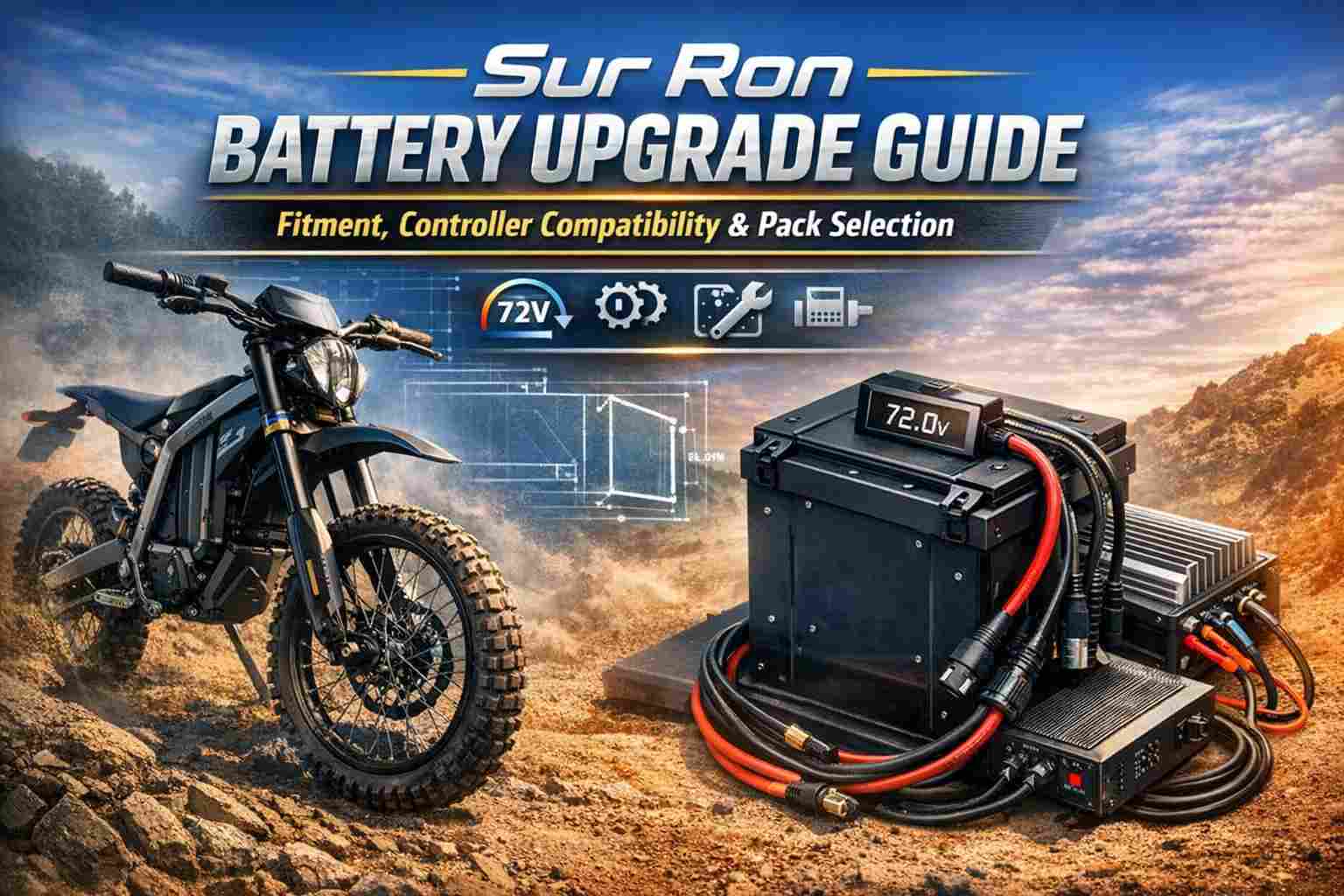
This Sur Ron battery upgrade guide explains more than voltage or capacity alone. The real challenge is making sure the battery, controller, charger, wiring, and enclosure all work together as one system.
For riders, builders, and OEM teams, the wrong battery can create more problems than performance. A pack that is too large may not fit correctly. A controller that is not matched to the battery voltage can limit performance or create reliability issues. A pack built without proper thermal design or vibration resistance may look powerful on paper but perform poorly in real off-road use.
This guide explains how to plan a Sur Ron battery upgrade with a focus on fitment, controller compatibility, and battery pack selection. It is designed for buyers who need a practical way to compare stock replacement options, 72V upgrades, and custom battery projects. For a broader overview of upgrade paths across different Sur Ron builds, see our Sur Ron battery upgrades guide.

What a Sur Ron Battery Upgrade Really Changes
A Sur Ron battery upgrade can change how the bike accelerates, climbs, and delivers power under load. But different upgrades solve different problems.
Some riders want more response and stronger output. Others need more ride time. For commercial projects, the focus may be on enclosure fitment, current handling, communication with the controller, or long-term reliability.
That is why a battery upgrade should be planned around three questions:
- What voltage does the system need?
- What battery size can the chassis actually fit?
- Which controller, charger, and wiring are compatible with that battery?
Without clear answers to these questions, the upgrade path is usually incomplete.
Sur Ron Battery Fitment: What You Must Check First
Battery fitment is one of the most common failure points in Sur Ron upgrade projects. A pack may offer the right voltage and capacity, but still be the wrong choice if it does not fit the available frame space or battery cover geometry.
Frame and battery cover clearance
The first step is checking the available battery compartment dimensions. Larger battery packs, especially higher-capacity 72V options, may interfere with the battery cover or require changes to the enclosure layout.
Enclosure design and mounting
Fitment is not only about battery size. It also includes enclosure thickness, latch geometry, connector routing, and how the pack sits under vibration and impact. For off-road applications, the enclosure must support both structural protection and thermal performance.
Weight and handling balance
A larger battery can improve range, but it also changes mass distribution. That affects handling, especially on technical terrain. In some builds, a slightly smaller pack gives a better overall result because it improves fitment and preserves riding balance.
Service access and charging access
The battery should also be designed for practical installation, removal, charging, and maintenance. A pack that barely fits may create long-term service problems.
Controller Compatibility for a Sur Ron Battery Upgrade

Controller compatibility is just as important as battery fitment. A battery and controller must be matched as a complete electrical system.
Voltage compatibility
A higher-voltage battery requires a controller that can handle that voltage safely. For example, a 72V setup must be matched with a controller designed for the fully charged system voltage, not just the nominal voltage.
Current capability
The controller and battery must also match on current handling. If the controller demands more current than the battery, BMS, wiring, or connectors can support, the result may be voltage sag, excess heat, or reduced reliability.
Charger and system matching
A battery upgrade also changes charger requirements. The charger profile must match the battery configuration, and the wiring harness must be sized for the intended current load.
BMS communication and smart control
In higher-performance projects, smart BMS integration can support diagnostics, balancing, and more controlled system behavior. This becomes more valuable as current, voltage, and riding demands increase.
60V vs 72V: Which Upgrade Path Makes Sense?
A 60V replacement path and a 72V performance path solve different problems.
When a 60V path makes sense
A 60V route is often better for simpler replacement projects, lower system complexity, and builds that want to preserve more of the original platform behavior.
When a 72V path makes sense
A 72V path makes sense when the goal is stronger acceleration, better climbing power, improved throttle response, and a more performance-oriented build. But it also requires more attention to controller matching, charger compatibility, wiring, and thermal control.
Why 72V projects need more engineering
Moving to 72V is not only about adding cells. Higher voltage and higher usable power create more thermal stress, stronger current demands, and tighter requirements for enclosure design and vibration resistance. That is why 72V projects benefit from a more engineering-led approach. If you want to compare these options at a higher level, our Sur Ron battery upgrade guide explains how different upgrade paths fit different project goals.
How to Choose the Right Battery Pack
The right battery pack depends on how the bike will actually be used.
For trail riding and general performance
If the goal is stronger trail performance, the focus should be on balanced current capability, manageable weight, and reliable fitment.
For aggressive off-road riding
For harder riding, battery design should emphasize thermal management, cell matching, structural reinforcement, and interconnect reliability under vibration.
For OEM or commercial projects
For OEM buyers, pack selection often includes enclosure customization, BMS settings, validation testing, and a roadmap from prototype to pilot run and volume production.
For model-specific builds
If the build is based on a specific Sur Ron platform, model-level fitment and controller details become more important than general battery specifications.
Common Mistakes in Sur Ron Battery Upgrade Projects
Many battery upgrade problems come from system mismatch rather than battery quality alone.
Common mistakes include:
- choosing a pack before checking frame dimensions
- upgrading voltage without changing the controller
- using a charger that does not match the battery profile
- underestimating heat in sustained high-load riding
- ignoring vibration resistance in off-road conditions
- selecting capacity only by range expectations instead of total system balance
A well-planned upgrade starts with fitment and compatibility, then moves to voltage and capacity selection.
When to Choose a Light Bee X-Specific Guide
Some Sur Ron projects need model-specific guidance rather than a general upgrade overview.
If the build is based on the Light Bee X platform, buyers usually need more detail on chassis fitment, aftermarket controller matching, and smart BMS integration. In that case, a model-specific guide is the better next step. For that scenario, read our sur ron light bee x 72v battery upgrade guide.
When to Choose a General 72V Guide
If the project is already moving to 72V, the next question is usually not whether to upgrade, but how to compare pack sizes, current capability, enclosure design, and system-level requirements.
For those projects, a 72V-specific guide is the better next step. For pack sizing, enclosure choices, and system-level requirements, see our Sur Ron 72V battery upgrade guide.
Custom Sur Ron Battery Development for OEM and Project Builds
For many B2B projects, a standard off-the-shelf battery is not enough. The battery may need to match unique dimensions, specific current requirements, custom BMS logic, or a more rugged enclosure for off-road conditions.
In these cases, battery development often includes:
- enclosure and dimensional review
- cell selection based on power and cycle-life targets
- BMS hardware or software configuration
- current path and interconnect design
- thermal strategy
- validation for vibration, load, and environmental exposure
A custom program is often the best option when fitment and controller compatibility are just as important as voltage and capacity. If you are defining dimensions, current targets, or custom BMS requirements, you can request a custom battery quote before finalizing the pack design.
FAQ
Can I upgrade a Sur Ron battery without changing the controller?
Sometimes, but it depends on the voltage path. Higher-voltage projects usually require a controller designed for the new battery configuration.
What is the most important part of battery fitment?
The most important factor is whether the battery truly fits the frame and cover area while still allowing safe mounting, wiring, and service access.
Does a bigger battery always mean a better upgrade?
No. A larger pack may improve range, but it can also increase weight, create fitment issues, and change handling.
Why does controller compatibility matter so much?
Because battery voltage, current demand, wiring, charging, and pack protection all depend on the controller being matched correctly.
Who should choose a custom battery pack?
Custom battery packs are a better choice for OEM projects, modified frames, special performance targets, or applications with non-standard enclosure constraints.
Conclusion
A good Sur Ron battery upgrade is not defined by voltage alone. It is defined by how well the battery fits the chassis, matches the controller, handles thermal load, and supports the way the bike is actually used.
For simple builds, a standard solution may be enough. For performance-oriented or OEM projects, fitment, controller compatibility, and battery engineering should be planned together from the beginning.
CTA
Need help defining voltage, fitment, current capability, or enclosure constraints for a Sur Ron project? Request a custom battery quote to discuss your build with our engineering team.


