

A swappable battery pack for urban mobility can help reduce vehicle downtime and improve daily operation. For scooter fleets, delivery eBikes, cargo bikes, and compact light electric vehicles, fast battery replacement can be more practical than waiting for each vehicle to charge.
However, a swappable battery system is not just a removable battery with a handle. The pack, connector, lock, charger, BMS, enclosure, and service process must work together. If one part is poorly designed, the system may create contact failures, water entry, user errors, or higher maintenance cost.
This article is part of our broader guide to urban mobility battery integration. It explains how OEM teams should design swappable battery packs around daily use, safety, charging workflow, service access, and long-term reliability.
What Is a Swappable Battery Pack for Urban Mobility?
A swappable battery pack is a removable battery designed to be replaced quickly during operation. Instead of keeping the whole vehicle connected to a charger, the user or service team can remove the low battery and install a charged one.
This approach is common in shared scooters, delivery eBikes, cargo fleets, and other urban mobility platforms where uptime matters. It can also help when vehicles are parked outdoors or used in places where fixed charging is not convenient.
For OEM teams, the main challenge is not only making the battery removable. The real challenge is making the system safe, repeatable, durable, and easy to manage across many vehicles and batteries.

Why Swappable Battery Design Matters
Urban mobility vehicles often operate under tight schedules. A delivery rider may need the vehicle available for most of the day, while a shared scooter fleet may need fast service turnaround. In these cases, charging time can become a business problem.
A well-designed swappable battery system can reduce downtime. It allows the vehicle to return to service quickly while the depleted battery is charged elsewhere. This can improve fleet availability and make daily operations easier to manage.
But poor swappable design can create new risks. Weak contacts, loose locks, poor sealing, confusing handling, or inconsistent charging can lead to faults in the field. These issues can reduce the benefit of battery swapping.
Key Applications for Swappable Urban Mobility Batteries
Electric Scooter Fleets
Electric scooter fleets are one of the most common use cases for swappable batteries. Service teams can collect low batteries, replace them with charged packs, and return the scooter to operation without moving the whole vehicle to a charging area.
For this model, the battery must be easy to remove, easy to identify, and strong enough for repeated handling. The connector and locking system are especially important because they may be used many times during the life of the vehicle.
If your project is focused on fleet scooters, see our guide to battery pack for electric scooter fleet. It explains how battery design affects uptime, charging, cycle life, service access, and fleet maintenance.
Delivery eBikes and Cargo Bikes
Delivery eBikes and cargo bikes often run for long hours and carry heavier loads than personal commuter bikes. A swappable pack can help riders continue working without waiting for a full charge.
For cargo and delivery use, the pack must be strong enough for vibration, frequent starts, road shock, and heavy current demand. The battery also needs a secure mounting system because any movement between the pack and vehicle can damage contacts over time.
In this category, the best design depends on how the fleet is operated. Some teams may want riders to swap batteries themselves, while others may use a depot-based service team. Each model creates different requirements for locking, labeling, charging, and battery tracking.
Commuter eBikes
Many commuter eBikes use removable batteries, but not every removable pack is designed for high-frequency swapping. A commuter user may remove the battery for home charging, office charging, or theft prevention.
For commuter platforms, the battery should be simple to remove but still secure during riding. The lock, rail, handle, and contact system must feel reliable to the user and should not become loose after repeated use.
For more detail on commuter platforms, see our guide to battery integration for commuter ebikes. It covers frame fitment, charging access, enclosure layout, and controller compatibility.
Light Electric Vehicles
Some light electric vehicles also use swappable battery packs. These may include compact utility vehicles, electric trikes, mobility carts, or small delivery platforms.
These vehicles may need larger packs, custom shapes, stronger mounting points, or different charging hardware. The battery may also need to be easier for service teams to handle, especially if the pack is heavy or used in a commercial setting.
For non-standard platforms, our guide to custom battery pack for light electric vehicle explains how OEM teams can plan pack format, enclosure design, and system integration.
Fixed Battery vs Swappable Battery Design
Before choosing a swappable design, OEM teams should compare it with a fixed battery system. Both approaches can work, but they support different vehicle designs and operating models.
A fixed battery may be simpler because the pack is handled less often. It can also reduce the risk of user damage or incorrect installation. However, the vehicle must be taken to a charging point, which may increase downtime in fleet operation.
A swappable battery can improve uptime because only the pack needs to be charged. But it also requires stronger connectors, better locking, clearer handling, and a safer charging process. The best choice depends on the use case, vehicle layout, rider behavior, and service plan.
Mechanical Design: Guides, Rails, Handles, and Locks
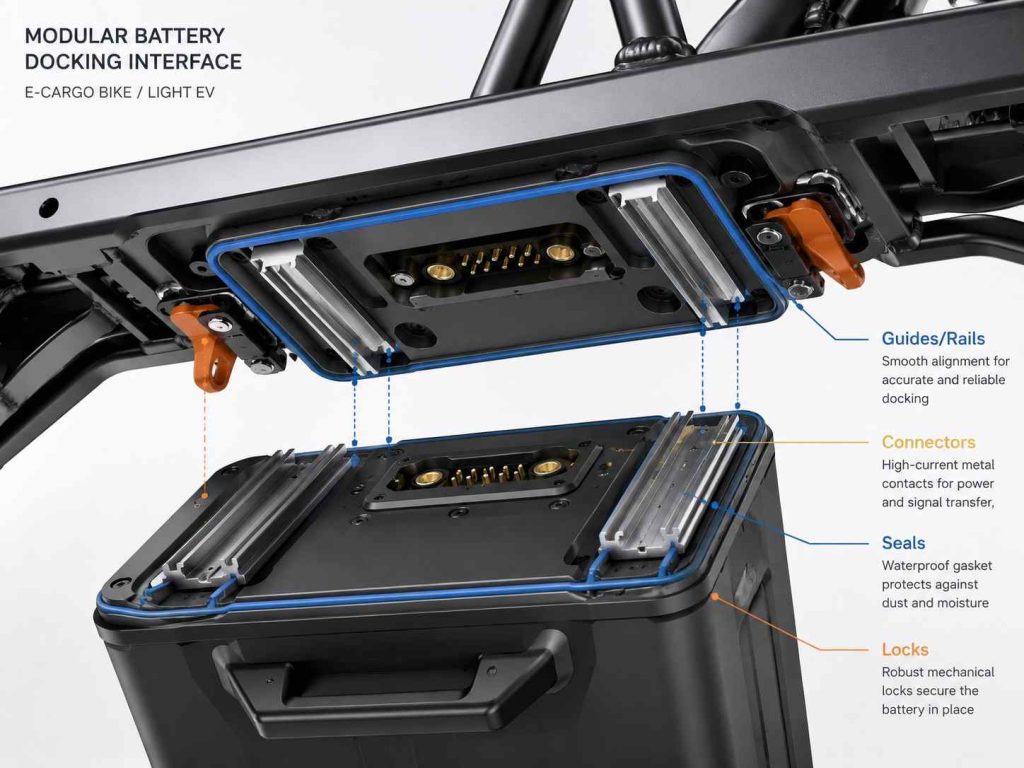
The mechanical design of a swappable battery system is critical. The battery must slide, dock, or insert smoothly without damaging the connector or case. It also needs to stay secure during vibration, braking, turning, and impact.
Guides and rails help control how the pack moves into position. They reduce the chance of misalignment and help protect the electrical contacts. If the pack is heavy, the guide system should also make handling easier for the user or service team.
The lock must be strong enough to hold the battery in place during riding. It should also be easy to use and hard to misuse. A weak lock can allow movement, noise, contact wear, or battery theft.
Connector and Contact Durability
Connectors are one of the most important parts of a swappable battery pack. They carry current, support charging or communication, and must remain reliable after repeated insertion and removal.
For swappable systems, contact pressure and alignment are critical. If the battery is not guided correctly, the connector may wear unevenly or fail to seat fully. This can cause heat, voltage drop, charging faults, or intermittent power loss.
OEM teams should review connector rating, pin layout, contact material, sealing method, strain relief, and replacement process. For fleet systems, it may also be useful to design connectors that are easy to inspect and service.
BMS Communication and Battery Identification
A swappable battery system often needs more data than a simple fixed pack. The vehicle, charger, or fleet system may need to know the battery’s state of charge, fault status, temperature, cycle count, or usage history.
This may require CAN, UART, SMBus, or another communication protocol. The exact choice depends on the controller, display, charger, and fleet management system. The communication design should be confirmed before the BMS is selected.
Battery identification can also be important. Fleet operators may need to track which battery is installed in which vehicle, how many cycles it has completed, and whether it has shown faults. This can support maintenance planning and reduce unexpected failures.
Charging Workflow for Swappable Batteries
Charging workflow is a major part of swappable battery design. The battery may be charged in a depot, charging cabinet, service room, or off-vehicle charger. Each method creates different requirements for connectors, safety, labeling, and user handling.
OEM teams should define the charging process early. Important details include charger voltage, charge current, cooling conditions, charge port location, battery identification, and whether charging data needs to be recorded.
A good charging workflow should reduce user mistakes. The system should make it clear which batteries are charged, which are depleted, which need inspection, and which should not be returned to service.
Water Resistance and Outdoor Use
Swappable batteries are often exposed during removal, installation, storage, and charging. This creates more environmental risk than a sealed fixed battery that is rarely handled.
Common weak points include connector faces, case seams, cable exits, lock openings, handle areas, and docking interfaces. These areas should be reviewed carefully, especially for scooters, cargo bikes, and outdoor fleets.
The design must balance sealing with service access. A pack that is too hard to open may increase repair cost, while a pack that is too easy to open may have poor protection against water or dust.
Safety and Compliance Planning
Swappable battery packs should be designed with safety and compliance in mind from the beginning. Standards, transport testing, and market requirements can affect cells, BMS settings, wiring, enclosure materials, labeling, and production testing.
For light electric vehicle battery applications, OEM teams may need to consider standards such as UL 2271 for batteries used in light electric vehicles. The exact path depends on the target market, sales channel, product type, and customer requirements.
Compliance should not be treated as a final paperwork step. If safety requirements are reviewed too late, the team may need to change the enclosure, wiring, BMS, or even the pack structure.
Service Access and Fleet Maintenance
A swappable battery pack should be easy to manage during daily service. Service teams may need to remove, inspect, charge, clean, store, and reinstall many packs every day.
Good design can reduce service time. Clear labels, strong handles, consistent connector positions, simple fault indicators, and easy inspection points can help technicians work faster and avoid mistakes.
The service model should be decided early. A rider-swapped system, a depot-swapped system, and a technician-only system may need different lock designs, battery weight limits, labeling, and data tracking.
Prototype Testing for Swappable Battery Systems
A swappable battery system should be tested under realistic use conditions before production. Basic electrical testing is not enough because many failures happen at the vehicle interface.
OEM teams should test insertion and removal cycles, connector wear, lock strength, vibration, water exposure, charging behavior, thermal rise, and user handling. The battery should also be tested with the actual vehicle, charger, and controller.
Prototype testing helps reveal problems that may not appear in CAD or bench tests. A pack may look correct in the design stage but still create service issues after repeated real-world use.
How EM3ev Supports Swappable Battery Pack Projects
EM3ev supports OEM teams developing custom lithium battery packs for urban mobility applications, including scooter fleets, delivery eBikes, cargo bikes, commuter eBikes, and compact light EVs. Our process can support early design review, cell selection, BMS setup, enclosure planning, connector layout, prototyping, testing, and production preparation.
Instead of designing the battery as a standalone part, we review how it works with the whole vehicle and service model. This includes mounting, locking, charging, BMS communication, connector durability, waterproofing needs, and long-term reliability targets.
For broader platform development, EM3ev also supports eBike and urban mobility battery solutions for OEM teams building commuter eBikes, cargo bikes, scooter fleets, eMTBs, and compact light electric vehicles.
Conclusion: Swappable Battery Design Must Support the Whole Operation
A swappable battery pack for urban mobility can improve uptime, charging flexibility, and service efficiency. But the design must be planned as a complete system, not only as a removable battery.
OEM teams should review the battery, enclosure, lock, connector, charger, BMS, vehicle interface, and service workflow together. This helps reduce contact failures, handling problems, water exposure, charging errors, and long-term maintenance cost.
If your urban mobility project needs a custom swappable battery pack, EM3ev can help review the technical requirements and develop a solution from prototype to production. Request a custom swappable battery consultation to discuss voltage, capacity, enclosure space, connector design, charging workflow, BMS requirements, and production goals.


